
What is a TMS or translation management system?
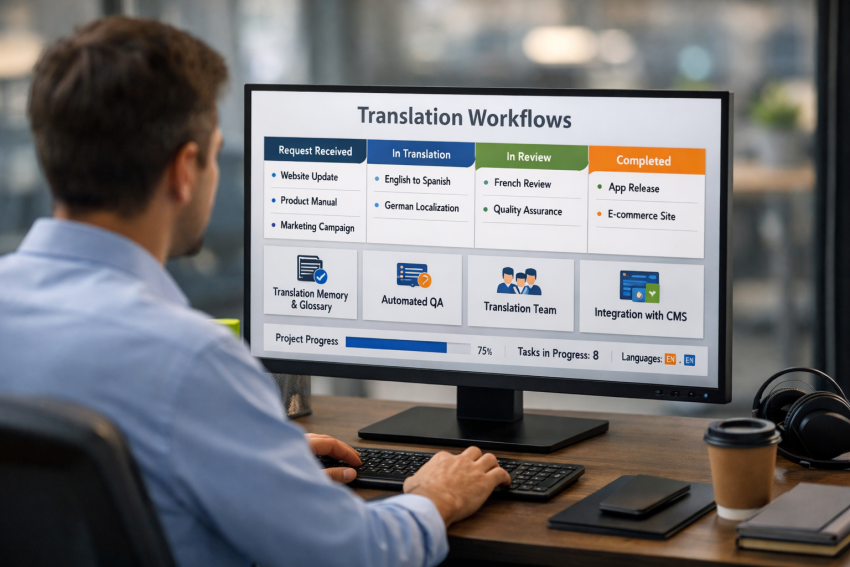
If you’ve landed on this blog explaining what a TMS or translation management system is, chances are you’re either still managing translations with spreadsheets and emails, or your team is growing and you need organisation, control and automation.
A TMS (Translation Management System) is software designed to centralise, automate and control the entire translation lifecycle: from the moment a request arrives (from a client, department or another company within the group) to publishing the translated content, with quality control, translation memories, glossaries, integrations and metrics.
In this blog, we’ll also take a look at 6 very popular TMSs, although this does not imply that they are necessarily the best. There probably isn't a “best” option; ultimately, it’s all about finding one that fits your actual needs at the best price.
Índice de contenidos
Index of contents
Index du contenu
Inhaltsverzeichnis
Indice dei contenuti
What is a “TMS” in the world of translation?
In the translation industry, TMS stands for “translation management system”. It helps coordinate people, content and tools in order to translate faster, with fewer errors and greater consistency.
It is worth separating two basic concepts:
- CAT (Computer-Assisted Translation) tool: the software used by translators to work segment by segment (translation memory, terminology, linguistic quality control).
- TMS: the management and automation layer (workflows, assignments, approvals, connectors, budgets, reports, etc.).
In practice, many translation companies or internal translation departments use a combination of both, or integrate them into packages that include TMS, CAT and automation.
How a TMS works in a real workflow
When a TMS is correctly set up, it can completely change your day-to-day work. It’s more than “just another tool”; it’s the backbone that connects content, teams and providers.
1) Centralises requests and reduces chaos
Instead of asking “who has the latest version?” or “what’s left to translate?”, a TMS provides a single entry point for projects, statuses and responsibilities, offering traceability (who approved what and when) with clear dates.
This is particularly handy when dealing with multiple languages, multiple teams or providers and a high volume of translation projects.
2) Automates repetitive tasks, avoiding human errors
TMSs typically automate tasks such as change detection (only new content is translated), pre-translation using translation memories, automatic quality checks (tags, variables, consistency) and integration with machine translation systems such as DeepL and OpenAI, among other features.
The key is not to automate everything, but to create workflows that make the process predictable, repeatable and controllable. For example, you can create a workflow that meets the requirements set out in the ISO 17100 standard on translation services.
3) Improves consistency with memories, glossaries and context
With a good translation memory and a terminology database, you no longer have to “reinvent” translations and can maintain consistency across teams, campaigns and versions. Translation memories allow you to reuse approved segments, cutting both time and costs.
4) Integrates with your ecosystem
A modern TMS is usually connected to other systems: CMS, code repositories, product tools, ticket systems, etc. This reduces copy-and-pasting and connects translation directly to where content is generated.
Cloud-based vs on-premises TMS: key differences and pros and cons
Choosing between a cloud-based and on-premises system is not just a technical decision: it affects costs, security, deployment speed and collaboration capabilities.
What each option entails
- Cloud (SaaS): accessed via browser, with hosting and maintenance handled by the provider.
- On-premises: you install the TMS on your servers (or infrastructure controlled by your organisation) and your team handles operation and maintenance.
Pros and cons of the cloud model
Pros: faster start-up and continuous updates; real-time collaboration and access for distributed teams; scalability without resizing servers.
Cons: complex integrations or exports if not well planned; compliance requirements on cybersecurity and information systems (check your data processing agreement, data locations and access controls).
Pros and cons of the on-premises model
Pros: greater control over infrastructure, networks and internal policies; suitable for highly regulated environments; alignment with corporate security requirements.
Cons: more expensive and time-consuming to manage (patches, updates, backups); scaling tends to be slower; collaboration with external teams can be complicated (VPN, access, permissions).
Six popular TMSs: history, headquarters and ideal buyer
1) memoQ (memoQ Translation Technologies)
- Year of launch (origin): 2004.
- Headquarters: Budapest (Hungary).
- Brief history: memoQ was created by three Hungarian language technology specialists —Balázs Kis, István Lengyel and Gábor Ugray— with the aim of improving collaboration among translators and the management of language resources. In 2006, the first public version of memoQ was launched, initially as a computer-assisted translation (CAT) tool. Over time, it has evolved into a complete TMS that integrates project management, server-based collaboration and workflow automation.
- Ideal buyer: localisation teams and language providers who want advanced control of language resources and collaboration.
2) Phrase
- Year of launch: 2012.
- Headquarters: Hamburg (Germany).
- Brief history: Phrase originated in 2012 in Hamburg, Germany, as a platform focused on translation management for software and digital products. Originally known as PhraseApp, it was designed to facilitate the continuous localisation of applications and websites, integrating directly with code repositories and agile development workflows used by product and development teams.
At the same time, Memsource was founded in 2010 in Prague, Czech Republic, by David Canek, with the aim of creating a cloud-based TMS that streamlines translation project management for companies and language service providers (LSP). Memsource quickly positioned itself as a modern alternative to traditional on-premises systems, thanks to its cloud-first approach, integrated machine translation engine and project automation capabilities.
In 2021, the company behind Phrase acquired Memsource and both technologies were progressively integrated into a single platform. Following this merger, the brand evolved into Phrase Localization Platform, a comprehensive suite that combines software localisation management, translation workflow automation, integration with development tools and multilingual project management. - Ideal buyer: digital companies (product, app, web, marketing) looking for integrations and rapid scaling.
3) RWS Trados
- Year of launch (origin): Trados was established as a company in 1984 in Stuttgart, Germany.
- Brief history: Trados was founded in 1984 in Stuttgart, Germany, as a company specialising in computer-assisted translation (CAT) tools. During the 1990s and early 2000s, its solutions, particularly Trados Translator’s Workbench and later SDL Trados Studio, became one of the de facto standards in the professional translation industry.
In 2005, the company was acquired by SDL, a British firm focused on language technology and global content management. Under SDL, the Trados ecosystem evolved significantly, incorporating new terminology management features, advanced translation memories and linguistic project management tools.
Later, in 2020, SDL was acquired by RWS Holdings, a British group specialising in intellectual property, linguistic services and language technology. Following this acquisition, the portfolio of language technologies became part of RWS, which today develops solutions such as Trados Studio and Trados Enterprise, combining widely used CAT tools for translators with translation management platforms for companies and global organisations. - Headquarters: RWS is a group based in the United Kingdom.
- Ideal buyer: professional translators, language teams and organisations that value a widely used ecosystem.
4) Smartling
- Year of launch: 2009.
- Headquarters: New York (USA).
- Brief history: Smartling was founded in 2009 in New York, United States, with the aim of modernising translation management for digital companies. From the outset, the platform was designed as a cloud-based TMS, aimed at simplifying the localisation of web content and applications through direct integrations with content management systems and development tools.
One of Smartling’s standout features was its early adoption of “in-context” translation, allowing translators to view text directly within the interface of a website or application, reducing errors and improving the consistency of the user experience. Over time, the platform has evolved to support automated localisation workflows, large-scale content management and integration with machine translation engines and enterprise systems, positioning itself as a solution aimed at companies that publish global content at scale. - Ideal buyer: companies with a high volume of web/app/help and integrations.
5) Lokalise
- Year of launch: 2017.
- Headquarters: founded in Riga, Latvia.
- Brief history: Lokalise was founded in 2017 by Nick Ustinov and Sergei Egorov, with its roots in Riga, Latvia. The platform was created with the aim of simplifying the localisation of digital products for development and product teams working with agile methodologies. From the outset, it was designed as a cloud-based solution, intended to integrate directly into development workflows through APIs, code repositories and project management tools.
- Ideal buyer: development and product teams that integrate localisation into the release cycle.
6) Crowdin
- Year of launch: 2009.
- Headquarters: founded in Ukraine, with current headquarters in Estonia.
- Brief history: Crowdin was founded in 2009 by Serhiy Dubovyk in Ukraine. The platform was created to facilitate collaborative localisation of software and digital products, especially in projects where developers, translators and user communities work together. From the very beginning, it was designed as a fully cloud-based solution, aimed at simplifying translation management in development environments and easily integrating with code repositories and project management tools.
- Ideal buyer: organisations with a high dependency on integrations and flexible collaboration.
How a TMS supports a professional translation strategy
A TMS provides structure; quality is achieved when processes are well designed and language resources (memories, glossaries, style guides) are kept up-to-date.
If your main challenge is to localise product and technical documentation, what you need is a TMS specialised in software translation (integrations, formats, terminology consistency). And if your focus is international promotion, translating your website will be key to not losing conversion due to lack of linguistic and cultural adaptation.
In any case, if you want to professionalise the entire process from start to finish and meet professional translation standards, well-designed workflows, quality checks and specialisation will make all the difference when the volume ramps up.
Conclusion
A TMS is not about buying the “latest software trend”; it’s about building a system with connected content, defined roles, smart automation and controlled quality. If you currently manage translations manually, a TMS can give you back time, consistency and peace of mind.
Other articles you may be interested in:


Josh Gambin holds a 5-year degree in Biology from the University of Valencia (Spain) and a 4-year degree in Translation and Interpreting from the University of Granada (Spain). He has worked as a freelance translator, in-house translator, desktop publisher and project manager. From 2002, he is a founding member of AbroadLink and is the Head of Sales and Strategy of the company.

Add new comment