
T-Mobile and language barriers: innovation or regulatory compliance issue?
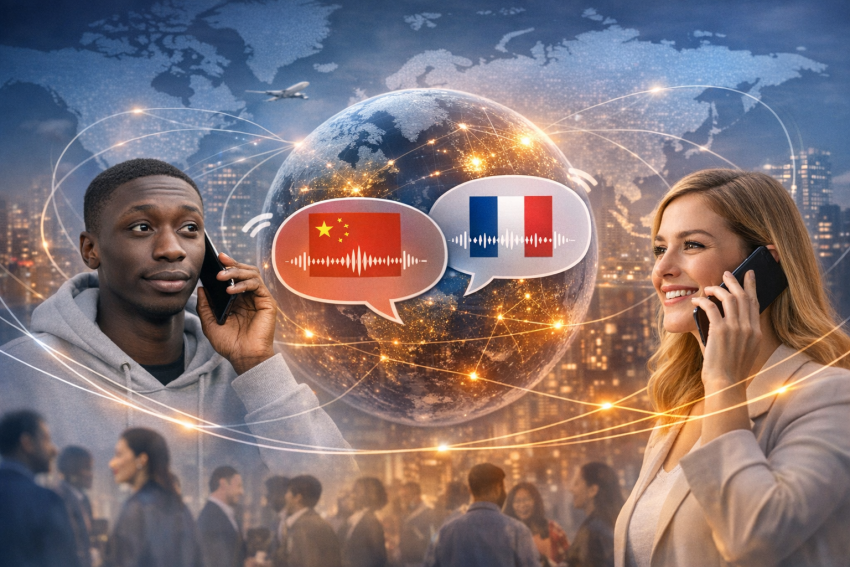
Translating a phone call into another language, without an app or complicated settings: that’s the promise offered by T-Mobile to break down language barriers. However, behind the technological innovation, regulatory compliance and data protection are key concerns.
Índice de contenidos
Index of contents
Index du contenu
Inhaltsverzeichnis
Indice dei contenuti
- Live Translation: a practical way to reduce language barriers
- How real-time call translation can break down language barriers
- Security and privacy: the real dividing line
- The Khaby Lame example: when identity becomes a “licensable” asset
- From a business perspective: a clear opportunity, accompanied by high demands
- When AI is not enough: how to secure your multilingual communications
- Conclusion: innovation is here, but trust will determine success
Live Translation: a practical way to reduce language barriers
The concept is simple: activate translation during a call, with almost immediate output, to reduce language barriers over the phone. T-Mobile presents this feature under the name Live Translation and announces coverage of more than 50 languages, with an experience designed to remain “natural”. The technology behind live call translation has been discussed by several tech outlets such as CNET.
The key feature is that the telecom operator manages the translation through its network, instead of it being confined to your phone. This could enable use on a wider range of phone models and simplify access for non-tech-savvy users.
You can read more about how T‑Mobile is bringing real‑time translation to phone calls in this CNET article.
Access conditions and activation
According to published information, the translation must be initiated by a T-Mobile subscriber, while the other party can be on a different network. The call must also rely on VoIP technologies, such as VoLTE and, in some cases, VoWiFi or VoNR. Some articles refer to a code-based activation initially, with voice activation planned for the future.
How real-time call translation can break down language barriers
A spoken conversation is more demanding than written chat: high latency can lead to a broken exchange and the loss of subtle nuances. If fast enough, real-time voice translation can make translated phone calls practical for everyday use: for technical support, healthcare, family conversations or making appointments.
For businesses, the potential impact is even more apparent: multilingual customer service, sales prospecting, logistics coordination and after-sales service. The fact that translation becomes a telecom-level “building block”, rather than just an app, could accelerate adoption.
Security and privacy: the real dividing line
As soon as an AI “listens” to a call to translate it, the central issue is: where is the audio processed and what data is generated behind the scenes? Even if a service claims not to store recordings or transcripts, technical metadata, diagnostic logs or third-party providers may still be involved in the process.
Before deploying real-time voice translation in a professional context —or even for personal use in sensitive calls— it is important to understand where the data is processed, how long it is retained, who has internal access, what encryption is used and what user controls are available (e.g. opt-out or notifying the other participant).
Voice data: potentially sensitive information
In Europe, the use of voice data may raise issues similar to those of biometrics and identification, depending on the context. In the UK, ICO sets out the legal framework and the safeguards required when handling biometric data: ICO page on biometrics. The European Data Protection Board (EDPB) has also published guidelines on virtual voice assistants: EDPB guidelines on voice assistants.
The Khaby Lame example: when identity becomes a “licensable” asset
The debate goes beyond technology. In February 2026, several sources reported that an agreement involving Khaby Lame authorised the use of his identity (notably his voice and elements related to his image) to develop an AI-powered “digital twin”. For an influencer, this may be part of a monetisation and brand control strategy.
It can be seen in two ways: on one hand, it represents a logical development in the creator economy; on the other, it serves as a reminder that voice and image are becoming exploitable resources. References: People: TikTok Star Khaby Lame Sells Company and Authorizes Development of His 'AI Twin' in $975M Deal; EUIPO: Development of Generative Artificial Intelligence from a Copyright Perspective.
And this raises an open, very specific question for call translation services: in the future, will users have to grant increasingly broad permissions over their voice to access these features, similar to the way some creators do for their AI avatars?
From a business perspective: a clear opportunity, accompanied by high demands
Live call translation can lower barriers in customer support and enhance the user experience, as long as both quality and latency are up to standard. The ecosystem is evolving rapidly. For instance, in February 2026 Krisp unveiled a real-time voice translation SDK (software development kit) designed for customer experience platforms: Business Wire press release on the Krisp SDK. A real-time voice translation SDK enables the rapid integration of instant voice translation into an application or service.
In practice, a company often has to strike a balance between speed and control: what data is transmitted, what information obligations apply, and what risks are acceptable depending on the sector (healthcare, legal, finance, industry, etc.).
When AI is not enough: how to secure your multilingual communications
Machine translation is improving, yet it remains unreliable in the presence of specialised terminology, negotiation, legal issues, or situations with significant operational consequences. A hybrid approach often works better: AI to speed things up, and linguists to oversee terminology, style and regulatory compliance.
In fields such as healthcare, law, finance and regulatory compliance, real-time call translation carries significant risk, as the slightest error (negation, unit, technical terminology, contract clauses) can have serious consequences.
The main issue is the lack of a validation step: the translation is delivered instantly and may be taken as accurate, even if an essential nuance has been lost.
A smooth conversation can therefore create a false sense of reliability.
In these contexts, AI translation should remain an aid to understanding, not a basis for decision-making.
Whenever a point is critical, human validation should be included (interpreter, reformulation and confirmation or a reviewed written record).
If you need to manage multilingual content such as documents, websites, software and support materials, you can rely on our services: a translation service for your ongoing projects, software translation when UX and terminology consistency are essential and conference or remote interpreting when spoken content requires maximum accuracy.
Conclusion: innovation is here, but trust will determine success
T-Mobile's promise is enticing: making real-time voice translation available as a telecom service could truly reduce language barriers and improve the flow of conversations, both in everyday life and in business. If quality and latency are up to standard, this technology could become widely adopted in many applications.
But large-scale adoption will depend above all on trust. As soon as an AI “listens” to a call to translate it, key questions resurface: where is the audio processed, what data (including technical metadata) is generated, which subcontractors are involved in the chain, and what guarantees exist regarding encryption, security and compliance?
Finally, beyond the technical aspects, the question of user consent and control remains central. The example of Khaby Lame reminds us that voice and image are becoming exploitable assets, prompting a key question: in order to access these services going forward, will users need to provide progressively wider voice permissions, or can translation be used without sacrificing privacy?
Other articles you may be interested in:



Ahlaam Abdirizak is a first-year Master’s student in International Business Development in Angers and a Marketing Assistant at AbroadLink Translations. Trilingual, with roots spanning both Africa and Europe, she combines her multicultural background with a passion for digital marketing. Creative by nature, she has a particular interest in producing multilingual content.
Add new comment