
Multilingual UDI and EUDAMED: succeed with your 2026 submissions
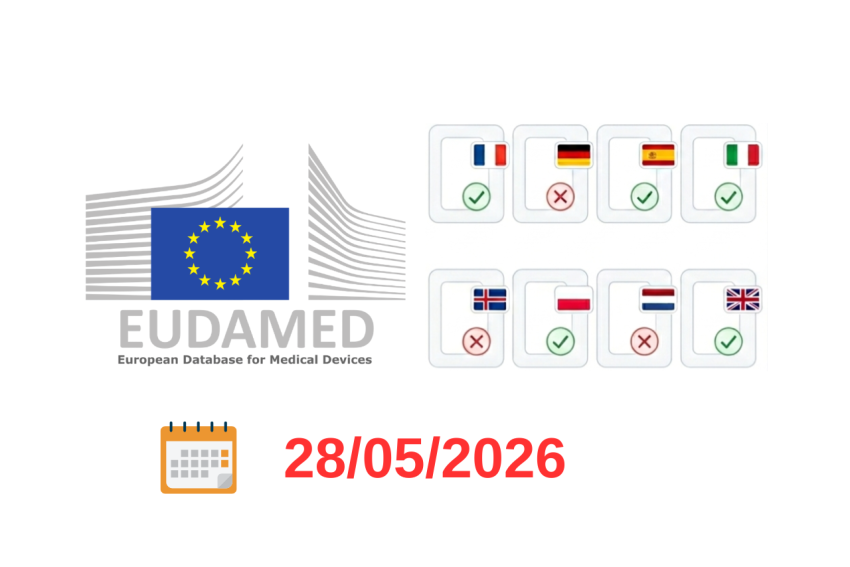
EUDAMED is the European database designed to centralise key information on medical devices, in a system intended for use across the EU (official EUDAMED overview). In this context, the Unique Device Identifier (UDI) is a cornerstone of device identification and traceability (EU UDI page) that manufacturers often need to manage in multiple languages.
Remember: the first EUDAMED modules, including UDI/Devices, become mandatory from 28 May 2026 (European Commission announcement). For context and implications, see our article: EUDAMED becomes mandatory in 2026.
Índice de contenidos
Index of contents
Index du contenu
Inhaltsverzeichnis
Indice dei contenuti
What a “multilingual UDI” submission in EUDAMED means
Multilingual does not mean “translating all of EUDAMED”. It involves preparing specific fields (often related to user comprehension and country requirements), aligning them with your labelling and IFUs, and then submitting them consistently across languages.
The MDCG language recommendation specifies that, in the UDI “core data” (Annex VI), only a few fields are expected in free text: additional product description (optional), storage and handling conditions and critical warnings or contraindications. It also recommends a practical approach: provide English and the languages of the Member States where the device is made available (MDCG 2018-7: languages in the UDI database).
In parallel, the UDI/Devices guide (as published through ANSM) shows that the tool allows entries by language, for example, adding a trade name in another language, and requires multilingual descriptions in certain cases (e.g., “Other/Autre” values for warnings or conditions) (UDI/Devices user guide (PDF)).
Prepare your multilingual content before entry: the 5-step method
1) Define your language matrix (and your pivot language)
Start by listing the countries where the device will be made available. This list determines your target languages. In many organisations, English serves as the pivot language, even if the source documentation is in a different language.
From the outset, define who validates what: regulatory affairs, quality, clinical and product managers. This prevents last-minute revisions on sensitive fields, particularly warnings and contraindications.
2) Separate structured data from language-specific content
Codes, value lists and identifiers should not be translated. Conversely, free text fields require rigorous language management. Combining them can result in validation errors and inconsistencies across systems.
This separation also facilitates automation (exports, XML, M2M flows) and corrections: simply update the matrix and regenerate your submission.
3) Standardise free text fields (fewer variations mean fewer risks)
For storage and handling conditions and critical warnings or contraindications, the goal is not a marketing style, but a clear, unambiguous meaning. Avoid paraphrasing from one language to another, as this complicates review and increases the risk of inconsistencies with the IFU.
Also anticipate “Other/Autre” cases: the UDI/Devices guide indicates that multilingual descriptions may be required if “Other” is selected for certain attributes (see the UDI/Devices guide).
4) Implement multilingual quality control prior to submission
An effective control combines: (1) data control (formats, completeness); (2) specialised language control (terminology and meaning); (3) validation of alignment with labelling and IFUs. This three-tiered review significantly reduces correction cycles.
To help you anticipate practical cases, an FAQ is available on the EUDAMED support platform (EUDAMED FAQ).
5) Handle error feedback without breaking consistency across languages
In automated workflows, a submission generation can produce error reports and require corrections in the source data before resubmission.
The golden rule in multilingual management is to perform corrections in batches rather than language by language. Failure to do so may result in cross-language inconsistencies that are difficult to identify.
Common multilingual errors in EUDAMED (and how to avoid them)
Inconsistencies between EUDAMED, labelling and IFUs
The trade name, descriptions and certain warnings must remain consistent across all materials. However, since EUDAMED allows entries by language, without a terminology reference, you can soon end up with multiple variants.
Solution: a validated multilingual glossary plus template sentences for sensitive free text fields, then strict reuse of these formulations.
Insufficient language management (incorrect field, incorrect language code, copy-paste errors)
A common mistake is to leave a language for later, copy-pasting the English or entering text in the wrong field. The issue becomes apparent when reviewers compare languages or when the information needs to be understood locally.
Solution: a language matrix, a completeness checklist and a final check to ensure both presence and equivalence of meaning prior to submission.
Unanticipated “Other/Autre” values
Selecting “Other” may trigger the obligation to add a multilingual description. Without preparation, this can lead to rushed translations and terminology discrepancies.
Solution: prepare a library of pre-validated “Other” descriptions, by case type, for all languages in your matrix.
How a specialised agency can help secure your multilingual submissions
As May 2026 approaches, multilingual content often slows things down: limited reviewers, tight deadlines and high demand for consistency across systems. A specialised translation agency like AbroadLink Translations helps you industrialise processes while maintaining accuracy with controlled terminology, specialised reviews and version control.
Specifically, we can handle the translation and validation of UDI free text fields (storage/handling conditions, warnings/contraindications), terminology harmonisation across languages and alignment with your documentation. For further information, please see: Translation of medical devices and medical translation.
Conclusion: turning multilingual UDI into a compliance advantage
The 28 May 2026 deadline signals a shift: UDI/Devices submission in EUDAMED will become a recurring process that must remain reliable with each product, market and language update.
To succeed, multilingual data must be treated as regulatory data in its own right: defined language matrix, standardised free text fields, locked terminology and quality checks before submission. Following this approach minimises rework, ensures alignment with labelling and IFUs and improves readability for EU stakeholders.
By planning ahead, you can benefit in two ways: reducing corrections during critical phases and establishing a coherent EUDAMED database that saves time later. And as volumes or languages increase, support from specialists (medical device linguists, regulatory reviews, terminology management) ensures quality without slowing down your RA/QA teams.
Other articles you may be interested in:



With a background in Marketing and International Trade, Alex has always shown a passion for languages and an interest in different cultures. Originally from Brittany, France, he has lived in Ireland and Mexico before spending some time back in France and then settling permanently in Spain. He works as Chief Growth Officer at AbroadLink Translations.
Add new comment