
Managing Translation of your Medical Device Post-Market Surveillance

Your IFU Is Translated. But Are Your Complaints Being Understood Correctly?
After launch, your most decision critical inputs rarely arrive as controlled documents. They arrive as multilingual Post-Market Surveillance (PMS) data for medical devices: complaint narratives, distributor field reports, service notes, user support emails, local hospital feedback, and app reviews for software medical devices.
In PMS practice, translation quality is not about writing polished English. It is about whether the original meaning survives intake well enough to support complaint triage, coding, escalation, investigation, trend analysis, CAPA, PSUR and PMCF inputs, vigilance assessment, and risk management updates. The lifecycle expectations sit in Regulation (EU) 2017/745 (MDR) and Regulation (EU) 2017/746 (IVDR). For day-to-day PMS interpretation, many teams keep the MDCG 2025-10 post-market surveillance guidance close at hand.
This is why medical device post-market surveillance translation is a PMS control point. If multilingual evidence is mistranslated, oversimplified, or interpreted inconsistently, the PMS system can miss signals or build trends on distorted inputs.
Índice de contenidos
Index of contents
Index du contenu
Inhaltsverzeichnis
Indice dei contenuti
Why Incoming PMS Evidence Is Language Sensitive
Incoming complaint and vigilance narratives are not written to be translation friendly. They often contain local shorthand, incomplete context, and mixed terminology. Meaning is lost most often through small changes that matter operationally:
- qualifiers removed, such as “sometimes”, “after cleaning”, “only when rotated”
- uncertainty replaced with certainty
- component references normalised incorrectly
- severity cues softened or omitted
- timelines simplified and recurrence removed
Those losses matter because the text is the basis for classification decisions that determine what you investigate, what you escalate, and what you trend.
Coding and IMDRF: Medical Device Translation Quality
Many complaint handling systems rely on standardised adverse event terminology and the essential principles of safety and performance of medical devices so similar events can be aggregated across sites and countries. In practical terms, multilingual solutions must retain enough meaning to support consistent selection of terminology for the device problem and any health impact.
The most usable entry point is the IMDRF Adverse Event Terminology web browser. The IMDRF work closely together with the MDCG and their specialised output is used as the regulatory basis for the MDR/IVDR regulations required adverse event reporting. You do not need translators assigning codes. You need translations that preserve the attributes coders map to. If that meaning collapses, you get cross market coding drift, and trend analysis starts reflecting language variability rather than device performance.
This is where medical device complaint translation becomes measurable. If the narrative is translated consistently, the coding is also more consistent. If the narrative is simplified, coding diverges.
PMS Scenario: How One Oversimplified Translation May Be Risky
Device: infusion accessory connector
Channel: distributor report in Spain into a central complaint system
Original Spanish narrative:
Tras la desinfección, el conector queda flojo y a veces gotea. Se nota holgura al girarlo.
Oversimplified intake summary: Connector leak after disinfection.
What changed and why it matters:
- “queda flojo” and “holgura” indicate loosening and mechanical play, not just leakage
- “al girarlo” ties the behaviour to rotation and fit at an interface, not purely a seal defect
- “a veces” indicates intermittency, which affects recurrence logic, escalation triggers, and trending thresholds
Operational consequence:
- Coding drift: some teams code leakage, others code connection or fit issue. The same mechanism splits across categories and weakens signal visibility.
- Escalation delay: leakage may be treated as familiar and lower risk. Progressive loosening after reprocessing points to a degradation mechanism with different risk implications.
- Investigation misdirection: early testing focuses on seals, not interface wear or disinfectant compatibility.
- CAPA and reporting distortion: CAPA scope shifts because the initial problem statement under specifies the mechanism. PSUR and PMCF summaries understate the pattern, and that slows evidence based medical device risk management translation updates when the risk file needs to reflect what is happening in the field.
Why IMDRF Term Translations: When Will They Come?
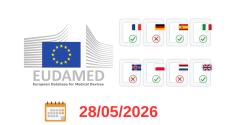
Many PMS teams have experienced uncertainty because validated, harmonised translations of IMDRF adverse event terminology across EU languages have not always been straightforward to access and govern consistently. In operations, that gap tends to produce local mapping and bilingual interpretation, which increases cross market variability. Even on the IMDRF Website they warn the user that “these are automatically generated translations”, therefore not trustworthy.
The EU has moved to address this issue. HaDEA published an EU4Health call for tenders focused on translation and validation work for the European Medical Device Nomenclature (EMDN) and IMDRF adverse event terminologies. The tender notice describes translation and validation of the IMDRF adverse event terminologies into EU official languages, alongside review and harmonisation work on EMDN translations.
For PMS teams, the value is practical. Validated multilingual terminology resources can reduce reliance on ad hoc interpretation and help align coding and trending across EU markets and with that, also ensure compliance and traceability.
A Practical Takeaway: Post-Market Surveillance Translation Matters
If multilingual intake loses meaning, your post-market surveillance system does not just translate poorly. It classifies inconsistently, trends unreliably, and investigates less efficiently. That noise flows into CAPA, PSUR and PMCF narratives, vigilance assessments, and risk management updates.
If you use external language support, keep it evidence focused and traceable. Make sure the language service provider holds certifications like the ISO 13485 to ensure its specialization and commitment to medical translation. Double-check if your provider is aware of all EU resources and if they are capable to create their own glossaries to ensure compliance when translating PMS data or IFUs. Some teams refer to medical device translation resources when defining expectations for clinical terminology, complaint narratives and safety-related language, while keeping vendor selection separate from PMS decision-making. When you need a single point of contact for controlled language support, professional translation company can be one option to evaluate alongside internal capability and QMS requirements.
Other articles you may be interested in:


Alejandra Keller is a German and Spanish native speaker with a high level of proficiency in English. She holds a translation degree from the University of Heidelberg and has lived and studied in Germany, the United States, Ireland, Spain and Peru. With a strong passion for international communication, she is currently working as Project Manager at AbroadLink.
Add new comment