
TaaF: When translation becomes a native feature of your products
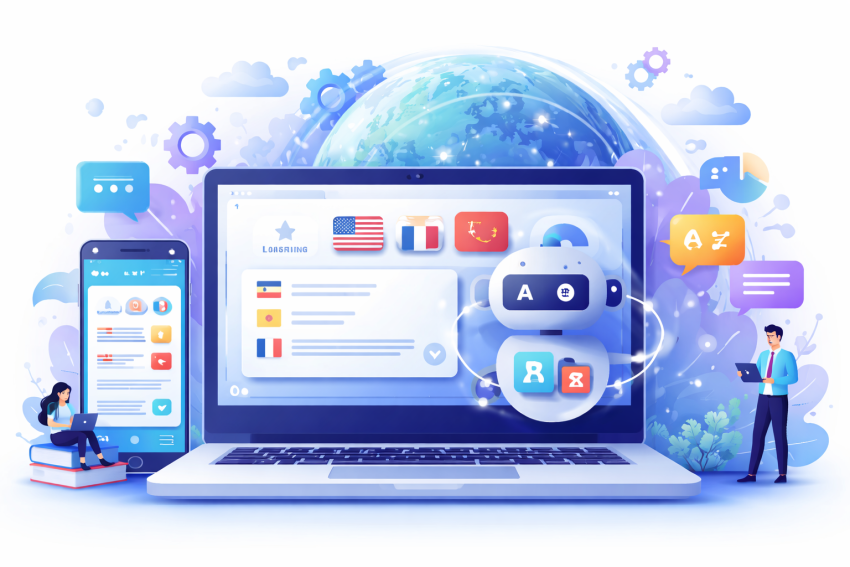
Translation as a Feature (TaaF) represents a simple but significant shift: rather than sending content out for translation, it is integrated directly into the software, platform or workflow. A 'Translate' button, an API, an automated option in the interface... and translation becomes a product capability, at times invisible, yet consistently more accessible.
This shift is accelerating with AI, particularly large language models (LLM). The Slator report on the subject presents 20 case studies illustrating how software providers are integrating translation into their applications, outlining the feature, output context, technologies and cost for the end user (Slator Report on Translation as a Feature (TaaF)).
This article provides a clear overview of TaaF, the tangible benefits, the often underestimated risks and a pragmatic method for implementing it without losing control over quality, compliance and user experience.
Índice de contenidos
Index of contents
Index du contenu
Inhaltsverzeichnis
Indice dei contenuti
- Understanding TaaF: definition and specific examples
- Why is TaaF progressing so quickly?
- What impact does TaaF have on your teams and workflows?
- The real benefits: speed, scalability, adoption
- The major risks (and why they occur)
- Implementing a 'controlled' TaaF: a 6-step method
- When to move from TaaF to full localisation
- Conclusion: TaaF is an opportunity... if you stay in control
Understanding TaaF: definition and specific examples
TaaF refers to integrated translation: the user no longer needs to send files to a provider or follow a separate localisation process. Translation is performed within the tool, at the moment the content is created, validated or published.
This approach differs from 'traditional' localisation (projects, batches, external validation cycles): in this model, translation becomes a productivity feature, designed for large-scale use, such as collaboration, support, internal documentation, knowledge base, e-learning and tickets. The Slator report highlights that translation is becoming increasingly ubiquitous in enterprise applications, including in sensitive environments.
It can already be seen in everyday use: platforms are adding translation to content creation, document management, project management and content editing tools. The key factor is not speed alone, but distribution: translation is placed in the hands of non-language specialists, reshaping governance models.
Why is TaaF progressing so quickly?
1) Business pressure: going global faster
For many organisations, translation is no longer a one-off 'project', but an ongoing process. TaaF responds to an operational reality: producing and maintaining multilingual content at the pace of team activity, without creating bottlenecks.
In this context, TaaF is particularly attractive to product and support teams, as it shortens the distance between the creation, distribution and use of multilingual content.
2) AI makes integration 'easy'... at first glance
APIs, connectors and LLMs make it easier to integrate translation into a product. The Slator report underscores a shift towards integrating translation directly into applications, rather than as an external service.
Yet it is precisely this perceived 'ease' that can become risky: when translation is just one click away, it can also be published with a single click, without control, validation or traceability.
3) Localisation changes from a purely linguistic challenge to a core product consideration
An effective TaaF programme looks more like a security or data analysis feature than a 'translation purchase'. It is important to consider roles and permissions, activity logs, quality thresholds, environments (draft vs production), monitoring and escalation procedures.
In other words, TaaF is effective when treated as a product feature, with well-defined rules and guardrails.
What impact does TaaF have on your teams and workflows?
Autonomy: TaaF allows non-specialised teams to produce multilingual content, including product sheets, internal notes, knowledge bases, microcopy and training materials. This is useful, and often indispensable, when volumes skyrocket.
Decentralisation: the downside is immediate; when departments publish independently, this can quickly lead to inconsistent terminology, variations in tone and potentially critical errors. A risk-oriented analysis emphasises this point: the issue is not whether to activate the feature, but to define how and when it should be used, and when to involve a human (translation_as_a_feature_TaaF).
User experience: integrated translation is not just about text. It affects the interface (label length, truncation), formats (dates, numbers, units), and product consistency (terminology, system messages, tone). That is why a translation_agency is not just about 'translating sentences': it is a matter of product decisions.
The real benefits: speed, scalability, adoption
TaaF works particularly well when you have large volumes of recurring content (support materials, help centre, internal notes), fast update cycles (SaaS, documentation, release notes), and distributed teams that need instant access to information.
The Slator report illustrates this trend through its case studies and emphasises that they cover a wide range of environments, with forms of language production that go beyond text, including text-to-text, speech-to-speech, speech-to-text and text-to-speech.
The major risks (and why they occur)
1) Quality risk: visible... or invisible errors
A marketing translation error can be embarrassing. However, with the rise of automated tools integrated directly into products, the risk increases: without a formal review stage, validation process and clearly defined accountability, as implemented by a translation company, quality can quickly be compromised.
In areas such as HR, healthcare, security and law, the issue is not limited to 'language quality'. It also concerns the lack of business context, structured terminology management and validation by a responsible person. Without these guardrails, a simple inaccuracy can turn into a serious incident.
To explore these issues in more detail and discover how to build a reliable framework around your multilingual projects, read our dedicated article on the AbroadLink Translations blog.
2) Compliance and data risk: where does your content go?
As soon as AI-powered translation is integrated, the handling of data must be clearly defined (personal data, confidential information, trade secrets). If data leaves the EU/EEA, the GDPR framework requires strict oversight of transfers and appropriate safeguards. The CNIL outlines the principles governing data transfers outside the EU (CNIL: data transfers outside the EU and GDPR).
3) Security risk: access, logs, governance
In a TaaF architecture, translation becomes part of a processing pipeline. Best security practices (risk management, access control, continuous improvement) are often structured around recognised standards such as ISO/IEC 27001: 2022 information security.
4) UX and internationalisation risk
Without solid i18n foundations, technical debt quickly builds up: encoding, Unicode management, formatting, sorting, text direction, etc. The W3C (World Wide Web Consortium) stresses the importance of designing products that support internationalisation across the entire stack. I18n (short for 'internationalisation', with 18 letters between the “i” and the “n”) refers to the technical practices that allow a product to be easily adapted to multiple languages and markets without major redesign. The W3C is the international body that defines Web standards to ensure interoperability, accessibility and international compatibility of web technologies.
Implementing a 'controlled' TaaF: a 6-step method
1) Classify your content by risk level
Before translating 'across the board', categorise your content: low risk (internal collaboration), medium risk (help centre, onboarding), high risk (legal, compliance, health, HR, security, finance). This classification determines the level of control: human post-editing, validation, or a prohibition on automatic publication.
This step prevents you from applying the same workflow to content with varying levels of impact and significantly reduces the likelihood of incidents.
2) Define simple governance
Decide who has permission to translate, who is authorised to publish, which content must go through review and how to escalate to a reviewer. This embodies the concept of 'guardrails' recommended in a risk-centred approach.
In practice, a few clear rules (roles, permissions, logs, validation) are often enough to secure 80% of scenarios.
3) Industrialise terminology (and make it accessible)
Without a glossary, TaaF can rapidly result in inconsistent translations across languages. Implement a product glossary, rules for tone and example sentences. For commercially valuable content, this is often the difference between being 'multilingual' and 'truly localised'.
If you have a web strategy, linking this work to website translation also improves terminological consistency and user experience.
4) Choose the right workflow: AI only, AI + human or human only
A strong model uses AI to accelerate the initial translation, followed by a human review for high-risk content, with automated QA checks on variables, tags, numbers, prohibited terms, etc. If your goal is quality aligned with an established standard, ISO17100: 2015 Translation Services outlines the process and resource requirements necessary for providing a translation service.
The goal is not to restrict autonomy, but to reserve human intervention for where it adds the most value.
5) Measure quality (rather than assuming it)
Define usable metrics such as return/correction rates, terminology errors, review time and and sample-based audits. TaaF works when it is managed like a product, driven by iterations, continuous improvement and feedback loops.
Without measurement, you will never know whether TaaF truly reduces turnaround times, or simply shifts the cost to correction.
6) Prepare for internationalisation and software localisation
If your goal is to translate an interface or software, the i18n foundation cannot be overlooked. W3C resources help structure these best practices. And if your product evolves quickly, treating translation as a continuous flow is often the most realistic strategy.
In this context, TaaF can act as an accelerator, as long as it is integrated into a solid architecture (i18n, testing, QA, monitoring).
When to move from TaaF to full localisation
TaaF does not replace everything. You will benefit from switching to more controlled localisation when launching a product in a strategic market, when your content is regulated, or when your brand relies heavily on style and tone. In these cases, TaaF remains useful (internal support, pre-translation), but external publication warrants a more robust process.
To explore this subject further, the Slator Report on Translation as a Feature (TaaF) provides a useful overview: it presents 20 case studies and describes how the feature is implemented in software solutions (features, technology, cost, etc.).
Conclusion: TaaF is an opportunity... if you stay in control
TaaF makes translation more accessible, faster, and better integrated into the everyday work of teams. However, the more accessible it becomes, the greater the need for guardrails covering governance, security, compliance, performance metrics and user experience. Without a structured framework, the risk is not limited to linguistic quality: it can become regulatory, reputational and operational.
Approaching TaaF as a simple technical component would be reductive. It is best approached as a full-fledged product feature, integrated into a clear localisation strategy, with defined responsibilities, validation processes and measurable quality criteria.
To date, these tools do not always provide the same guarantees as a structured translation company: human supervision, traceability, contractual responsibility, terminology management, regulatory compliance and documented quality assurance. In many contexts, these guarantees are crucial.
At AbroadLink Translations, we support organisations that want to integrate these technologies intelligently, without compromising quality, compliance or risk management.
Other articles you may be interested in:


Ahlaam Abdirizak is a first-year Master’s student in International Business Development in Angers and a Marketing Assistant at AbroadLink Translations. Trilingual, with roots spanning both Africa and Europe, she combines her multicultural background with a passion for digital marketing. Creative by nature, she has a particular interest in producing multilingual content.
Add new comment